The Initial Question.
How can I use locally collected environmental sensor data to design automated systems that operate more efficiently?
Miles Phillips
November 19, 2025
This week I wanted to take my learning a step further and explore how artificial intelligence interacts with the physical world, not just with software. I’ve been watching Patrick Winston’s Artificial Intelligence lectures to strengthen my foundation in machine learning, and I recently met with Professor Clifton Phillips at San Diego Mesa College. He shared insights into his own work with AI and encouraged me to think more about local stimuli, sensors, and how physical systems respond to their environments.
Originally, I had a big idea: an AI-powered desktop terrarium or greenhouse that pulls in data from multiple sensors, feeds it into a machine learning model, and automatically adjusts light, humidity, and airflow to keep plants in balance. I still want to pursue that vision, but the hardware for a full build is a significant investment. So I decided to challenge myself with the hardware I already had.
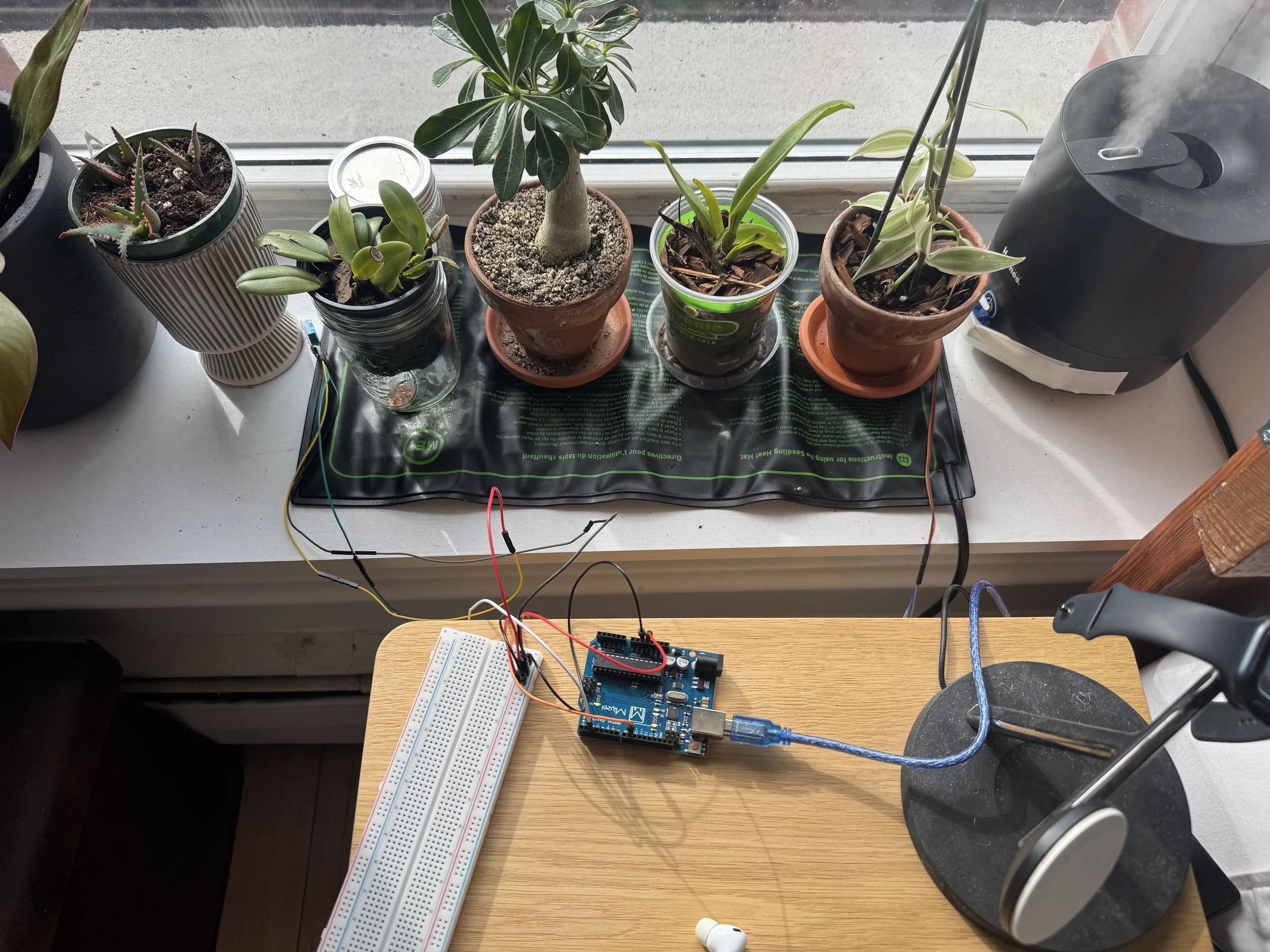
I found an old Arduino starter kit with a DHT11 temperature and humidity sensor and a small servo motor, which inspired me to narrow the project to humidity control. This was already a real issue in my own space, since my humidifier sits in a window sill with plants and tends to create condensation when temperatures drop.
The solution turned out to be surprisingly simple. The Arduino reads humidity and temperature in real time, decides whether the humidifier should be off, on high, or on low, and uses the servo to physically press the humidifier’s button. It’s a small project, but it solves a real problem and gave me hands-on experience building a responsive environmental control system.
To be clear, this isn’t Artificial Intelligence or Machine Learning. It’s basic environmental sensing paired with automated action. An Arduino isn’t powerful enough to run ML models, and while an Nvidia Jetson could, it’s both expensive and too vulnerable to moisture to sit near plants or water. In a future version, the Arduino would act as a low-cost middleman that gathers sensor data and sends it to a Jetson placed somewhere safe and dry. That’s actually the ideal structure for a scalable system.
A true machine learning version would behave with much more nuance and proactively than what I built this week. Instead of simply reacting to humidity in the moment, it could incorporate context like weather patterns, temperature forecasts, seasonal changes, or historical environmental data. It could predict humidity or temperature shifts and act before they happen.
For now, this prototype is just one part of a larger goal I’m working toward: exploring how emerging technology can be incorporated into design to promote sustainability.
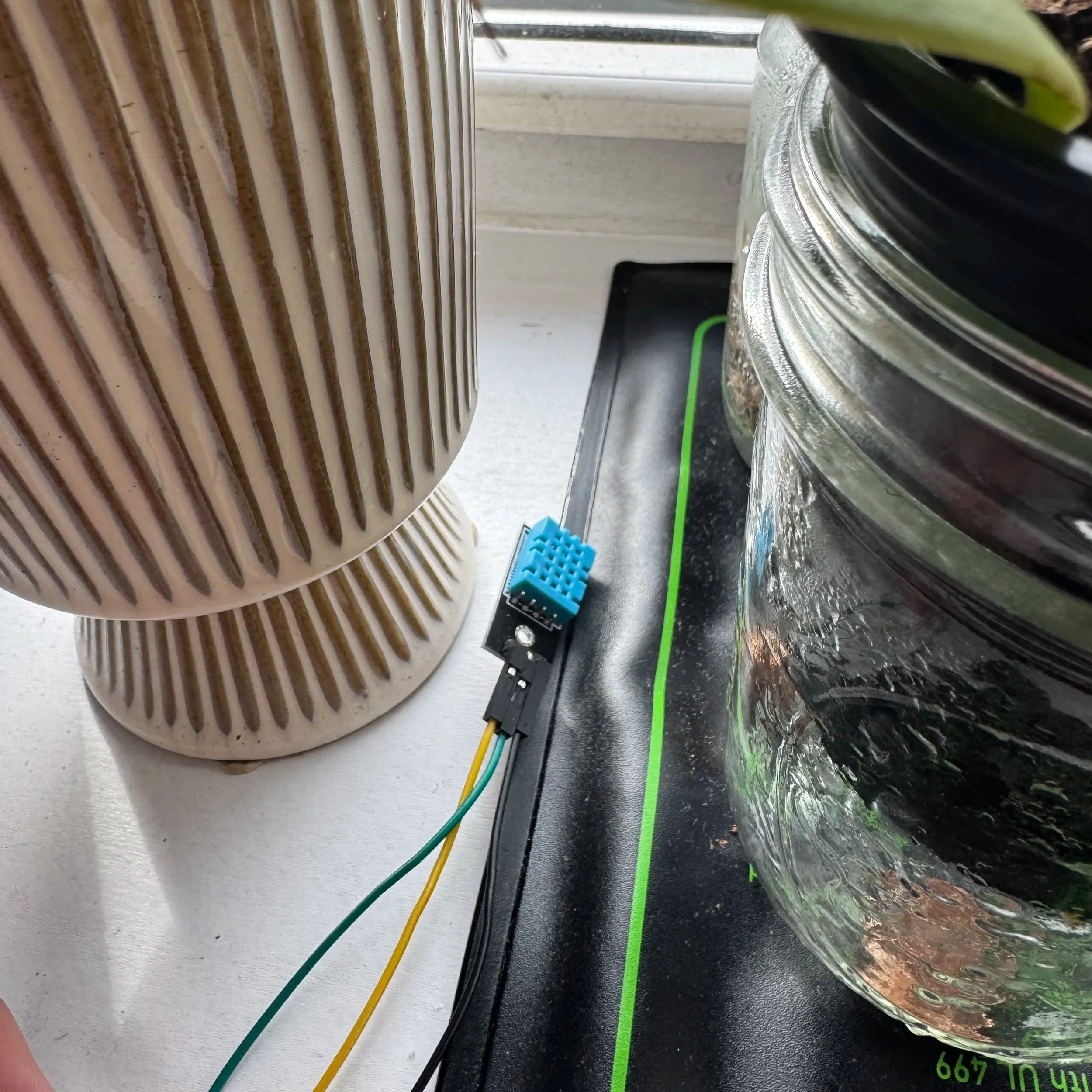
ST0248 Humidity & Temperature sensor located at the opposite end of the windowsill as the humidifier.
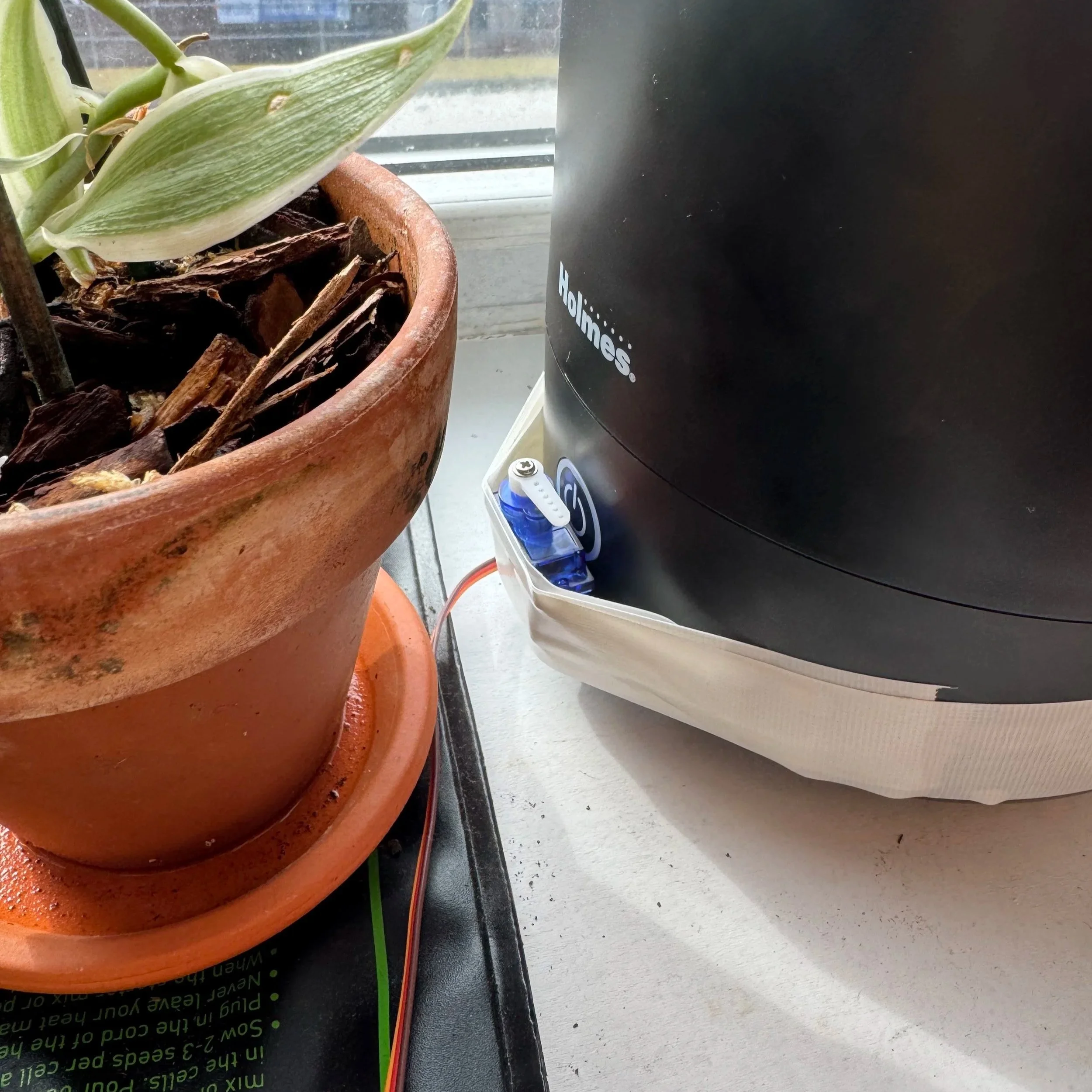
Servo Motor fixed to the surface of my humidifier to physically cycle the humidifier through OFF, HIGH, and LOW settings.